Military Resource

Warfare,
Warriors & Empires.
| Ancient Military | |
|
Ancient Empires
|
|
 |
|
|
Egyptian Military
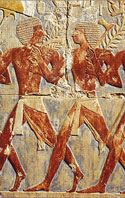
Egyptain light infantry, armed with an early axe and throwing sticks weapons. |
|
 |
|
|
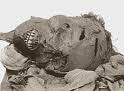
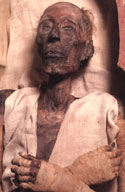
Pharoah Seqenenre |
|
 |
|
|
|
|
 |
|
|
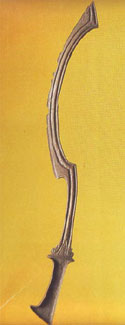
Egyptian Khopesh An improved weapon, also called the sickle sword that developed from an axe in the Near East. |
|
The Military of Ancient Egypt |
 |
 |
||||
| The ancient Egyptian military, like all armies, was a product of the society that created it. Although it was not militarily innovative itself, Egyptian society could be very conservative. The Egyptian military readily adapted enemy weapons and technologies, becoming a powerhouse of the ancient world and one of the great military forces of history. The ancient Egyptians were a blessed kingdom. Few nations have had their ideal position. They were defended naturally from attack by geography and were united as a people. The deserts protected the flanks of Egypt, while their northern border was protected by the Mediterranean Sea. The Nile River flowed from south to north, and five cataracts protected the southern border. Additionally, the Egyptians had the advantage of being ethnically and culturally unified, an advantage when it comes to governing. Most nations have the additional problem of disparate groups constantly attempting to break away and revolt. Egypt, however, was united under their Pharaoh, a king who was considered to be a god on earth. For hundreds of years, the Egyptians prospered, their cities not even requiring defensive walls, and their people were secure. |
||||||
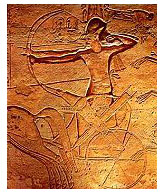
| Ancient Egyptian Military Relief of Ramses II, depicting him in the Battle of Kadesh |
Ancient Egypt: Empire of Wealth |
|||||
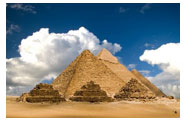 |
The Great Pyramids Built at Giza, Egypt, in the |
|||||
|
Egypt’s defensive advantages were not enough to stop the conquering Hyskos, who invaded at the end of the Middle Kingdom. The Egyptians learned from their defeat and reinvented their army, ushering in a new age of military glory. The Egyptian lands of the Archaic Period, Old Kingdom and Middle Kingdom were not devoid of armies or enemies, however. Nomads raided from the desert; Libyans attacked the Nile delta; and the Nubians threatened the southern border. The Pharaohs responded with force. Fortresses and outposts were built and garrisoned to protect the Nile delta, eastern desert and the southern border. If the threat was more substantial than a raid and the small garrisons couldn’t handle it, the Pharaoh would respond with an army. Dawn of Warfare: The Ancient Egptian MilitaryPre-Dynastic Egyptian Military and Warfare (prior to 3100 BC) Man’s history in the lands of the Nile extends back to the dawn of mankind and is one of the possible locations where man first crossed the line from violence to warfare. The first possible prehistoric battle in the archaeological record is on the Nile near the border of Egypt and Sudan. The site known as Cemetery 117 has been determined to be between approximately 13,140 to 14,340 years old. It contains 59 skeletons, along with many partial skeletons, many with arrowheads or spear points embedded in them, indicating that they may have been battle casualties. The wounds show no signs associated with healing. Some speculate that an increasingly arid climate may have caused greater competition, and there seems to be a quick decline in population at the end of the Paleolithic period. Others have questioned this conclusion, arguing that the bodies could have accumulated over decades, or even centuries. Perhaps the site is evidence of the murder of trespassers rather than an actual battle. They also point out that nearly half of the bodies are female, and thirteen are children. Archeologists have identified a string of Nile cultures spanning from the 14th millennium BC to the Dynastic period. These cultures developed from hunter-gathers and wild grain gathers to settled agricultural villages, and eventually, the mini-states that were forged into ancient Egypt. These societies are credited with many firsts for mankind and developed into one of our earliest urban populations. However the productive, but limited, areas available for farming caused conflict, first among bands of human struggling to make their first attempts at food production, then later between villages. Groups of desert nomads would have been attracted to the comparative paradise the Nile valley offered, with its vast flocks of birds, wild grains and animal life, and they needed to be repulsed. These conflicts would have been carried out using primitive weapons, clubs, stone maces, slings, throwing sticks, stone-tipped spears and stone-tipped arrows. Early bows were constructed using two antelope horns fixed to a handle. By 5500 BC, tribes had adapted to the annual flooding of the Nile for agriculture, and had mastered animal husbandry, creating food surpluses and villages. As their societies became more advanced, so did the complexity of warfare. Small raiding tactics evolved into armies, and they began to make shields of animal hide stretched over wood frames. Egyptian society had an early jump on the world stage, developing medicine, astronomy, mathematics, cosmetics, and domestication of animals, to name a few. They also broadened their world, making contact with Palestine and the Byblos coast. By 4000 BC, they began to import obsidian from Ethiopia to make razor-sharp blades. Over the next thousand years, they developed from scattered villages and hamlets to powerful civilizations, with kings in complete control of the people and resources of the Nile valley. The wooden simple bow (or self bow) had been developed by this time and replaced the older horn bows. They expanded their trade routes, developed writing and increased their territory along the Nile, until three cities dominated the valley and vied for complete control. The world’s first depictions of siege warfare can be found in reliefs depicting sieges and wheeled siege ladders. By 3150 BC, the king of Upper Egypt had had defeated the other two kings and taken control over all of Egypt. This may have been accomplished by a Pharaoh named Narmar, the so-called Scorpion King, who is the first known to be depicted with the symbols of a united upper and lower Egypt. Warfare in Egypt’s Archaic Period Old Kingdom Military & Warfare During the Old Kingdom, Egypt didn’t have a standing army. Instead governors of administrative divisions called Nomes were required to raise armies. When a force was needed all of the armies of the Nomes would be come together and be commanded by the Pharaoh. However, this created another problem for Pharaoh’s, occasionally Nomes created rival factions and vied for the monarchy in which case they needed to be forcibly suppressed through military action by the Pharaoh. Egyptian armies of the period consisted of archers and infantry men . Most infantry would be equipped spears, brandishing copper spearheads and a large shield. (Also, see Egyptian weapons.) These shields were the kind that used hides stretched over wooden frames. The design has been tested and it was surprisingly resilient. They are lighter then a pure wooden shield allowing for a larger size and their ability to flex allowed them to absorb blows that shattered wooden shields. Elite troops and leaders would have been armed with copper maces, ideal for bashing lightly armored foes but expensive. Archers carrying simple curved bows and arrows with arrowheads made of flint or copper backed the infantry. The reason the Egyptians returned to the simple curved bow from the recurved bow is unclear; perhaps they preferred its lower maintenance. Nubian mercenaries were said to have been their best archers. As the pharoah’s of the old kingdom concentrated on constructing their pyramids they slowly allowed more power to fall into the hands of the Governors of the nomes. Upon the death of the 94 year old pharaoh Pepy II Egypt fell into civil war. Without a clear heir the regional powers began to contend with each other for supremacy. Egyptian power waned in the following period, called The First Intermediate Period. Militarily Egypt would never be as secure again as it was in the Old Kingdom, now forced to contend with other rising powers in the near East. Middle Kingdom Military & Warfare Tactically and organizationally the Egyptian army remained similar to that of the Old Kingdom. Conscripted peasants and tradesmen continued to form the army, although the establishment of garrisons may have added to their professionalism. Tactically they continued to be heavily dependent on their archers. Around 2000 BC the first metal arrowheads made an appearance in their military made from hammer hardened copper. Bronze bladed axes began to appear in the infantry at this time. They were constructed with blade affixed into grooves on long handles. This was a weaker connection then the axes made by their contemporaries that feathered a hole through the axe head that the handle fit through, but it served their purpose of slashing unarmored troops and hacking through hide covered, wood framed shields. New infantry mercenary troops, called Maryannu, were hired from the Levant during the end of the Middle Kingdom. Unfortunately for the Egyptians there had been major advances weapons and tactics had been both developed and found their way into the Near East. The stagnant Egyptian military was on the brink of disastrous defeat. What may have started as peaceful migrations of Asiatic workers needed for building projects in the Nile delta ended with the militarily powerful Hyskos dominating the Nile Delta and ushering in the Second Intermediate Period. The Hyskos, meaning “Shepard Kings”, had Canaanite names and were of Semitic origins. They took over the Egyptian capitol Memphis and ruled from Avaris in the lower delta. New military equipment insured their ascendancy and domination of the locals. Archery advances such as, the composite bow, an improved recurve bow and improved arrowheads, were brought by the Hyskos. Infantry advances included various kinds of swords and daggers, a metal bound wooden shields, mailed shirts, and the metal helmet. However, it is their use of the horse drawn chariot that is most commonly cited as their greatest military advancement over the Egyptians. This may be an oversimplification though, there is evidence that both the horse and Chariot were known of by the Middle Kingdom Egyptians, apparently they just hadn’t incorporated them into their military forces at the time. The Egyptians that chafed under foreign rule flocked to Thebes in Upper Egypt. Here, on the upper Nile domestic Egyptian pharaoh’s still ruled. The Hyskos kings in Lower Egypt had styled themselves as Pharaohs and added the middle Egypt to their domain. The Nubians, or Kush, took the opportunity to assert their independence, trapping the Egyptians in an enemy sandwich. The Pharaohs in Thebes may first have been content to mine gold and make money off the Red Sea trade to care about their overrun countrymen down river. However, demands of tribute and taxes for access to the Lower Nile made a new generation of Pharaoh’s consider the foreign domination to be blight on their holy land. They retrained their army, adopted the deadly composite bow and built light, fast war chariots to their own specifications. Seqenenre Tao II, called “The Brave”, the Theban Pharaoh from c.1560 BC - 1558 BC, launched the first assaults against the Hyksos and their Pharaoh Apepi (also called Apophis). His mummies head features multiple, vicious axe wounds; he fell in battle against the Hyksos only two years into his reign. However, his sons would take up the banner of their fallen father. Kamose, called “The Strong”, the son of Seqenenre, inherited the throne from his now mummified father. Apepi, who had usurped the Hyksos thrown of Lower and Middle Egypt preferred to change the names on old monuments instead of having his own built. You have to admire the old ruler’s consistency. Apepi traded peacefully with the native Egyptians to the South, but like his Father, Kamose despised the Theban Pharaohs subordinate position. In the third year of his reign he launched his attack on the Hyskos, surprising and overrunning their southern garrisons. He then headed straight for their capitol and battled the Hyksos outside of Avaris itself. The city itself was not taken, but the Thebans devastated their fields. Kamose intercepted a letter requesting aid from the King of Kush, wounded from the battle he then sailed back up the Nile and dispatched forces to intercept any aid from Kush. In Thebes he celebrated his victory then died, most likely from his wounds. The Hyksos had been caught off guard, but weren’t much worse off. Kamose’s brother Ahmose then became the Pharaoh. He was more cautious then his father and brother and waited before resuming the war. Hyksos king Apepi died, he had been a contemporary of Seqenenre Tao II and ruled both Middle and Lower Egypt but at the time of his death the Hyksos had lost Middle Egypt. Kamose’s continuous campaigns and chariot-based army wore down the Hyskos. The Egyptians employed their own weapons and tactics against them, and after several campaigns against it the stronghold of Avaris was conquered. Egypt was once again under the domain of one Egyptian Pharaoh. The Thebans started to rebel against the Hyksos when Pharaoh Sekenre (or Senakhtenre) Taa became Pharaoh. Sekenre called the Thebans to a battle against the Hyksos, a battle that claimed his own life. Sekenre was succeeded by Kamose, who also attempted to battle the Hyksos, but spent only three years on the throne, before probably being killed in battle. Kamose’s brother Ahmose was far more successful than his predecessors. He battled the Hyksos, and drove them from Egypt. This marked the beginning of the New Kingdom. New Kingdom Military & Warfare A rich, noble warrior class joined the army as Charioteers, shooting powerful composite bows from their mobile platforms. The Egyptians made lighter, more agile chariots then their contemporaries. Two horses would pull the chariot and its two man team, one warrior handling the chariot while the other peppered the enemy with arrows. Spears would be employed for close combat and the warrior usually had some protection. Occasionally scale armor or a shield, but more typically thick leather straps across the chest. It was unnecessary to protect the lower body, as the chariot shielded it. The chariots were the masters of the battlefield during their day, providing both speed and long ranged attacks. The Egyptians preferred to use their chariots to stay out of range of their opponents, while devastating them with arrows. Other Near Eastern empires would send their chariots crashing into enemy formations, creating carnage with blades placed on their wheels (scythed chariots). Uniquely among the powers of the time, the Chariots of Egypt were state owned, instead of by individual warriors. Advances were also made in the Egyptian infantry. A sword called the khopesh came in to use. This iconic weapon was balanced both for slashing and stabbing and it featured a hook on one site of the blade. The hook could be used to pull an enemies shield down before the khopesh was lunged forward, stabbing the face, neck or chest. Infantry also began wearing armor, scale armor or leather tunics with metal scales sewn on them. Advances in armor lead to advances in axes; the old Egyptian slashing battle axe was replaced by a new piercing one. However, the Egyptians neglected to use the eyehole design of the Hysko’s Axe heads and never achieved their stability. Axes fell out of favor, probably due to a lack of need for armor penetrating weapons in their hot climate, the Egyptians preferred swords. While the superior composite bow, made of layers of bone and wood, was used by the Egyptians of this period, their very high cost and difficult maintenance would have made them less common. Composite bows offered greater range and the ability to penetrate scale armor. However, composite bows required them to be unstrung between uses and stringing them was not a simple task. It took two people and a lot of strength. They were also difficult to maintain, they had to be covered and protected from humidity. Composite bows were also difficult to construct, Egypt imported most of theirs from Egypt. For these reasons most of the bows used by the Egyptian military continued to be simple bows and recurve bows, composite bows were only given out to the elite troops and this usually meant the chariot warriors. During the New Kingdom, the Egyptian military changed from levy troops into a firm organization of professional soldiers. Conquests of foreign territories, like Nubia, required a permanent force to be garrisoned abroad. The encounter with other powerful Near Eastern kingdoms like Mitanni, Hittites, and later the Assyrians and Babylonians, made it necessary for the Egyptians to conduct campaigns far from home. Infantry troops were organized into large square formations by weapon type, Archers, swordsmen or spearmen. The New Kingdom also employed mercenaries to fill its ranks Sherden (one of the Sea Peoples), Libyans and Maryannu charioteers where all employed. A group called the Na’arn mercenaries were hired by Ramesses II, an ethnicity from Anatolia. Hebrews tribal infantry may also have served as mercenaries under Ramesses II. New Kingdom Egypt reached the zenith of its power under the Pharaohs Seti I and Ramesses II (Ramesses the Great), increasing Egyptian territory all the way to Syria in the Levant. Ramesses II campaigned vigorously against both the Libyans and the Hittites, fought in. During the battle of Kadesh Ramesses II fought the Hittites to a stalemate in what was probably the largest chariot battle ever fought, involving around 5,000 – 6,000 chariots. The stalemate resulted in the earliest known and physically surviving international peace treaty. An enlarged replica of the Kadesh agreement hangs on a wall at the United Nations headquarters. The reorganization and reequipping of the Egyptian military during the New Kingdom allowed them to engage the powerful Near Eastern kingdoms like Mitanni, the Hittites, and later the Assyrians and Babylonians. Egypt’s old enemies, the Libyans and Numidians also required military attention. Without the knowledge gained from the Hyksos the Egyptians never would have survived, especially from the onslaught of The Sea Peoples in the 12th century BC. The mysterious Sea Peoples, a confederacy of seafaring raiders and conquerors, smashed into the civilizations of the Near East. The ends of several civilizations around 1175 BC have lead to a theory that the Sea Peoples caused the collapse of the Hittite, Mycenaean and Mitanni kingdoms. They definitely destroyed some kingdoms of the Levant and may have been the catalyst for the Bronze Age Collapse (1206 - 1150 BCE). Characterized by the interruption of trade routes and extinguished literacy. In the first phase of this period, almost every city between Troy and Gaza on the Eastern Mediterranean was violently destroyed. An inscription in Egypt reads, “No land could stand before their arms, from Hatti, Kode, Carchemish, Arzawa, Alashiya on being cut down.” Carchemish in fact survived the Sea People's attacks, despite the Egyptian report. However, the ferocity of their invasions is not in doubt. Egypt proper was next on their hit list, and they needed a miracle, the Sea Peoples had already overrun all of their newly acquired territories in Asia. The army of Ramesses III met the Sea Peoples on Egypt’s Eastern frontier and defeated them in the Battle of Djahy (c. 1178 BC). Ramessess III largely credited his chariots for the victory in inscriptions. This was followed by an attack by the Sea Peoples naval fleet. At the following Battle of the Delta a great sea battle was fought between Egypt and the invaders. Ramesses III hid his navy in one of the many branches of Nile mouth and posted coastal watchmen. The enemy fleet was ambushed, then after a great ship to ship battle the invasion was repulsed. Survivors found in the waters of the Nile were dragged up on shore and executed ad hoc. However, this wasn’t the end, the raids continued for years. Ramesses III certainly scored a great and decisive victory against the invaders. However, after his death the Sea Peoples settled in Canaan and Palestine. One of these groups may have been the biblically mentioned Philistines, including their champion Goliath. The Egyptians were able to repulse the attack of the Sea Peoples on their homeland, but at a heavy cost. The conflict exhausted the Egyptian military and emptied the treasury to such an extent that Egypt would never again recover to be a powerful empire. The entire eastern world faced an onslaught from new invaders known as The Sea Peoples and slipped into a dark age. After these brutal conquers were repelled by Ramesses III their old enemies like the Libyans and Nubians rose up and then and invaded. Internal conflict was another cause of the fall of Egyptian power as a sect of priests contended with the Princes for Pharaoh the New Kingdom slipped into the “Third Intermediate Period” and Late period. It is often regarded as the last gasp of a once great culture, where the power of Egypt had greatly diminished. The Sheridans (a Sea Peoples) and Libyans took control of the Western portions of the Nile Delta while the Nubians took control of upper Egypt. The weekend and divided Egyptians were then unable to counter an Assyrian invasion and the lands of the Nile became part of the Assyrian Empire. Egypt was then ruled by foreign powers, the Assyrians, Persians and finally the Romans all were able to conquer and rule the once mighty empire. The Egyptian military would never again be a great force in the ancient world.
|
||||||